A Brief History of Photoshop and How It Changed the World
How two brothers built Photoshop on a Macintosh Plus in 1987, sold it to Adobe, and reshaped photography, advertising, and how we see images.
In Short
Photoshop was started in 1987 by a Ph.D. student named Thomas Knoll on his Mac Plus, just as a side project to display grayscale images. His brother John Knoll, who worked at Industrial Light & Magic, saw the potential and helped turn it into a real product. Adobe bought the distribution rights in 1988, shipped Photoshop 1.0 on February 19, 1990, and bought it outright in 1995 for $34.5 million. Over the next 35 years it became so common that "to photoshop" turned into a verb, and it changed photography, advertising, and how billions of people see the world.
Table of Contents
- It started as a side project
- Two brothers, one Mac
- How Adobe got involved
- The first Photoshopped photo
- Photoshop 1.0 ships
- Layers change everything
- Camera Raw and the digital photography boom
- Photoshop becomes a verb
- The subscription years
- AI takes the wheel
- How it changed the world
- Where we are now
If you have ever edited a photo on a computer, you have used software that exists because of Photoshop. It set the rules. It invented most of the words we still use: layers, filters, masks, brushes. And it started, like so many great things, with one person trying to solve a small problem on a slow computer.
This is the short version of how that happened, and what it did to the world.
It started as a side project
The year was 1987. Thomas Knoll was a Ph.D. student at the University of Michigan, studying computer vision. He had a brand-new Macintosh Plus, a beige all-in-one with a 9-inch black-and-white screen, 1 MB of RAM, and an 8 MHz processor. It could not display grayscale images.
That bothered him. So he wrote a little program in Pascal that could show grayscale pictures on a monochrome display by faking it with patterns of dots, a technique called dithering. He called it Display.
It was not meant to be a product. It was just a tool he made for himself, partly to have something to look at while he tested image-processing routines for his dissertation.
Two things primed Thomas for this. His father, Glenn Knoll, was a professor at the University of Michigan and a serious amateur photographer who built a darkroom in the family basement. Thomas and his older brother John grew up developing film and printing photos by hand. So when Thomas saw a digital image on a screen for the first time, he already had a darkroom photographer's instincts about contrast, exposure, and tonal range, and he knew exactly which controls he wished he had.
Two brothers, one Mac
Then his brother saw it.
John Knoll was working at Industrial Light & Magic, the visual effects company George Lucas built for Star Wars. He had recently joined ILM's new computer graphics group and was on early digital compositing work for films like The Abyss and Star Trek VI. John saw what Display could do, and he told Thomas: this could be more than a school project.
So the brothers kept adding features, mostly on weekends and evenings. Color support. Brightness and contrast curves. Selection tools. Filters. Plug-in hooks. The name went through a few iterations. Display became ImagePro, but that was taken. Then PhotoLab, also taken. They finally settled on Photoshop.
The work split was simple. Thomas wrote almost all of the code in Ann Arbor. John drove the feature direction from California, using ILM's professional needs as a wishlist: we need a way to do this in Hollywood, can you build it? Thomas would, and John would test it on real production work the following week.
In 1988 they did a small distribution deal with a scanner company called Barneyscan. About 200 copies of Photoshop shipped under the name "Barneyscan XP," bundled with their slide scanners. That was the very first time anyone outside the Knoll family used Photoshop in production.
How Adobe got involved
John Knoll then did the smart thing: he started showing the program around. He demoed it to engineers at Apple. He demoed it to SuperMac. He demoed it to Russell Brown, the art director at Adobe. Both Apple and Adobe demos went really, really well. But Adobe was the most interesting fit, because Adobe was the company behind PostScript, the technology that powered desktop publishing.
What is rarely told is that Adobe almost passed. The company had its own internal imaging project at the time, and Photoshop's pitch, a pixel editor for designers, was unproven. Brown championed the deal internally and pushed it through. He would go on to spend the next thirty years as Photoshop's most public evangelist, traveling the world doing live demos at design conferences.
In September 1988, Adobe agreed to license Photoshop and become its distributor. The Knoll brothers kept ownership. Adobe handled the marketing, the polish, the documentation, and the sales channel.
Seven years later, on March 31, 1995, Adobe bought Photoshop outright for $34.5 million. By that point it was already on its way to becoming the most important piece of creative software ever made, and that purchase price would later look like one of the great bargains in software history.
The first Photoshopped photo
There is one image that quietly anchors the entire history of Photoshop. It is a photograph of a woman with dark hair, sitting topless on a beach in Bora Bora, looking out at the ocean. Her name is Jennifer Walters. She is John Knoll's wife.
John took the photo on holiday in 1987, on a Canon film camera. He scanned it, dropped it onto his Mac, and used it to test almost every feature he and Thomas built into Photoshop. When he demoed Photoshop to Apple, to Adobe, to anyone, that was the demo image. He cloned a second island into the lagoon. He duplicated her. He stretched her, blurred her, color-shifted her. The photo became the unofficial test pattern of the entire industry.
For years, the original file sat on a CD-ROM in John Knoll's office. He never thought of it as historic. In 2014, the artist Constant Dullaart tracked it down and posted it online, calling it "the most photoshopped image in history." It has been edited, cropped, and reproduced more times than almost any other photo ever made, and almost none of those reproductions are in any museum, because Jennifer was not famous and the photo was never published. It just happened to be the picture John Knoll grabbed first.
Photoshop 1.0 ships
The first official version, Photoshop 1.0, shipped on February 19, 1990. It was Mac-only, it cost $895, and it fit on a single 800 KB floppy disk. The "About" box credited Thomas and John Knoll by name, a personal touch that survived for decades.
By today's standards it was almost laughably simple. There were no layers. No undo history beyond a single step. No adjustment layers. No history palette. You opened one image, you edited it, and you saved it. If you made a mistake, you started over.
But for the time, it was magic. Designers could now retouch photos on a desktop computer instead of doing it by hand in a darkroom with airbrushes, masking tape, and chemical baths. The dot-com era had not even started yet.
Then came the upgrades:
- Photoshop 2.0 (June 1991) added paths (vector curves used for selections), CMYK color separation for offset printing, and most importantly a plug-in architecture. That single decision turned Photoshop into a platform: third parties could now ship their own filters and tools. Kai Krause's "Kai's Power Tools" arrived in 1992 and sold by the truckload, and the plug-in API set the template every other image editor copied for the next twenty years.
- Photoshop 2.5 (November 1992) brought Photoshop to Windows for the first time, suddenly opening it up to the massive PC market. It was also the first version distributed on CD-ROM rather than floppy disk.
Layers change everything
Then in September 1994, Photoshop 3.0 shipped. It added the single feature that defined Photoshop forever: layers.
Before layers, every edit was destructive. You painted on the photo, and the paint replaced the pixels underneath. There was no going back. Compositing two images meant getting the math right on the first try.
Layers changed that. Now you could stack things on top of each other, hide them, move them, blend them. You could put the sky on one layer and the people on another. You could try things and undo them without losing the original. Combined with blend modes (Multiply, Screen, Overlay, and the rest), layers turned Photoshop from an image editor into a real compositor.
The idea was not entirely new. Live Picture and Cosa had explored similar concepts earlier. But Photoshop made it work for everyone. This one feature is the reason designers and photographers everywhere stopped fighting Photoshop and started loving it. Almost every image editor that came after Photoshop copied this idea, and the file format Adobe invented to store it (.psd) became a de facto industry standard.
The next decade kept adding more, and the rhythm became reliable: each release fixed something painful from the last one.
- Photoshop 4.0 (November 1996): adjustment layers (so color and tone changes were finally non-destructive too) and actions for recordable automation.
- Photoshop 5.0 (May 1998): the History panel, so you could undo dozens of steps instead of one. Editable type. Color management with ICC profiles. The "magnetic lasso" selection tool.
- Photoshop 5.5 (February 1999): bundled with the new ImageReady, and shipped Save for Web. This is the feature that fueled the early visual internet. Every JPEG and animated GIF on the late-90s web was probably exported through this dialog.
- Photoshop 6.0 (September 2000): vector shape layers, layer styles, and a new layout that became the visual blueprint Photoshop still mostly uses today.
- Photoshop 7.0 (March 2002): the Healing Brush, which removed blemishes in one click while preserving texture. The first real "AI-feeling" tool, even though it was just clever math.
Camera Raw and the digital photography boom
Around 2002, something quietly massive happened: digital SLRs got affordable. Canon's 10D, Nikon's D100, and the early Rebel hit working photographers' price ranges. And those cameras shot in a new format almost nobody knew how to handle: proprietary raw files, with every camera maker using its own variant.
Thomas Knoll wrote the answer. In February 2003 Adobe released the original Camera Raw plugin, written almost entirely by Thomas, that let Photoshop open raw files from any major camera and develop them with sliders for exposure, white balance, contrast, and shadows. It started as a $99 add-on. By Photoshop CS in October 2003 it was bundled in.
This is the unsung pivot. Camera Raw turned Photoshop from a graphic-design tool into the photography backbone of the next twenty years. The same engine still powers Adobe Lightroom, which Adobe began developing shortly after and shipped in 2007.
Photoshop becomes a verb
Around the year 2000, something started happening in popular language. People stopped saying "edit this photo" and started saying "photoshop this photo." The brand became the action. By 2008, the Oxford English Dictionary added "photoshop" as a verb. Adobe's lawyers were not thrilled (genericized trademarks tend to get harder to defend), and the company quietly issued style guides asking journalists to please use it as an adjective.
This is a rare thing. Only a handful of brands have done it: google, uber, xerox, zoom. Photoshop joined that list because it was so dominant that it became the default way to think about image editing.
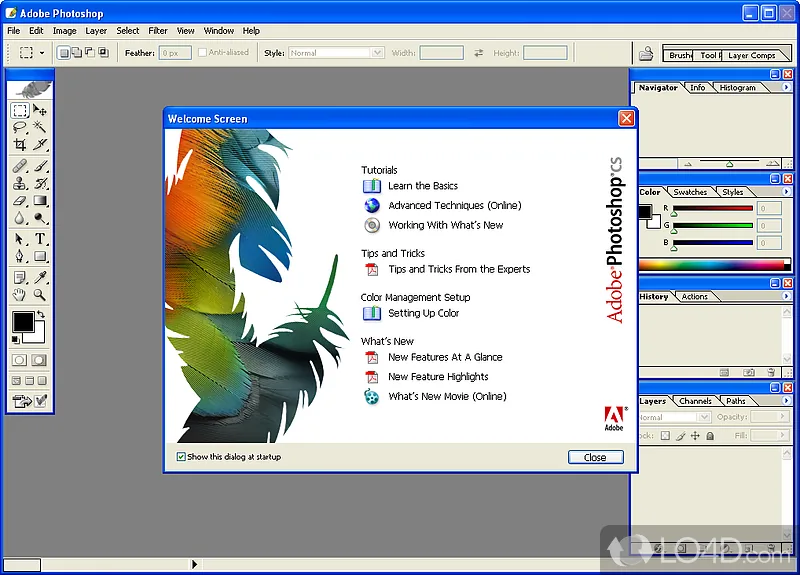
The Creative Suite era arrived in October 2003 with Photoshop CS (officially version 8.0). Adobe rebranded the whole product line and started shipping new versions roughly every 18–24 months:
- CS2 (2005): Smart Objects (non-destructive embedded files), Vanishing Point (paint along a perspective plane), and the Spot Healing Brush.
- CS3 (2007): the Quick Selection tool and a redesigned interface; also the first version with a proper Intel-native build for the new Intel Macs.
- CS4 (2008): Content-Aware Scale (resize a photo without distorting people), Adjustments and Masks panels, and GPU-accelerated zooming and rotation.
- CS5 (2010): Content-Aware Fill, which could erase entire objects from a photo by guessing what should be behind them; Puppet Warp; and a vastly improved HDR Pro. This was the version where Photoshop started to feel closer to magic than software.
- CS6 (2012): the new Mercury Graphics Engine for GPU-accelerated filters, Content-Aware Move, and a dark UI by default. It would also be the last version of Photoshop you could buy outright.
The subscription years
In May 2013, Adobe pulled a controversial move: they announced that CS6 would be the last boxed Photoshop. After that, in June 2013, Photoshop CC (Creative Cloud) shipped, and the only way to get it was a monthly subscription. Instead of paying once, you paid every month. Forever.
The reaction was loud. A Change.org petition collected over 50,000 signatures. Designers wrote angry blog posts. Photographers threatened to switch to Pixelmator, GIMP, Affinity Photo. Adobe responded a few months later by introducing the Photography Plan, Photoshop and Lightroom together for $9.99/month, which calmed the photography community while still locking everyone into recurring revenue.
It stuck. And it changed the entire software industry. Adobe's revenue model became the template for almost every creative tool that came after: Figma, Sketch, Affinity (which held out the longest), even web hosts and font foundries. Today almost every creative tool charges a subscription, and Adobe is the company that proved it could work at scale.
In return, updates got faster. New features stopped waiting for big-bang releases. Photoshop for iPad shipped in November 2019: a real, layer-compatible version of Photoshop on a tablet, something that would have seemed impossible a few years earlier. Apple Silicon native support arrived in 2021, making Photoshop dramatically faster on M1 Macs. New AI-powered selection tools showed up almost every quarter, often hidden behind unassuming names like "Select Subject" or "Object Selection."
AI takes the wheel
In May 2023, Adobe added Generative Fill and Generative Expand to the Photoshop beta, powered by their Firefly AI model, trained largely on Adobe Stock to keep the output commercially safe. By September 2023, Generative Fill was generally available in Photoshop 25.0. You could now select an empty area, type "a cat sitting on a chair," and Photoshop would draw it in. You could expand a photo's canvas in any direction and the model would fill in plausible surroundings.
This was the second time Photoshop redefined image editing. The first was layers in 1994. The second was generative AI in 2023. In between, image editing was mostly about giving humans better brushes. Now the software paints alongside the human.
The follow-up has been a parade of model upgrades: Generative Workspace for batch experimentation, Distraction Removal that erases people, wires, and trash from a scene with one click, integration with third-party models like OpenAI's image generators, and Firefly Image 3 and 4 with progressively more photorealistic output. The pace is now closer to a tech company than a software publisher.
How it changed the world
Photoshop did not just change software. It changed culture in ways that are still playing out.
It changed advertising. Before Photoshop, retouching a magazine cover took a team of specialists, an airbrush, and a lot of time. After Photoshop, one person at a desk could do it in an afternoon. The look of every billboard, magazine, and product photo you see today was shaped by this.
It changed movies. Industrial Light & Magic, the place where John Knoll worked, used Photoshop on Jurassic Park, on Star Wars prequels, and on hundreds of other films. The matte paintings behind your favorite scenes were almost always touched by it.
It changed photography itself. Photographers stopped needing perfect lighting, perfect framing, or perfect skies. Mistakes that used to ruin a shot could now be fixed. This made photography more forgiving, but also more uniform. Everyone's photos started to look "fixed."
It changed how we see beauty. Magazine covers became smoother, thinner, brighter. Skin became flawless. Bodies got reshaped. A whole generation grew up looking at images that were not real, comparing themselves to people who do not exist. The backlash eventually reached governments. Israel passed a "Photoshop Law" in 2012 requiring disclosure of digitally altered models in advertising, and France followed in 2017, mandating that retouched commercial photos carry a "photographie retouchée" label. This is the part of Photoshop's legacy that is hardest to celebrate.
It changed truth. A photo used to be evidence. After Photoshop, a photo became a starting point. News organizations had to write entire ethics policies for what counted as acceptable editing. Most settled on the rule that whatever you could do in a darkroom was fine, but the line kept moving. Reuters, the AP, and others have fired photographers over edits that would seem mild today. We now live in a world where any image can be questioned, and that mistrust started long before deepfakes existed.
It built an entire profession. Before Photoshop, a "retoucher" worked in a print shop with a brush and dye. After Photoshop, retouchers became digital artists, freelance specialists, and post-production studios employing dozens of people. A whole layer of the visual economy (book covers, album art, video game splash screens, event-photography post) exists because Photoshop made it economically possible.
Where we are now
Thirty-five years after that first floppy disk shipped, Photoshop is still the standard. The interface has changed a lot. The features have multiplied. The price went from $895 once to about $22 every month, or roughly $264 a year, every year, for as long as you want to keep using it. But the core idea is the same one Thomas Knoll wrote on his Mac Plus in 1987: pixels you can move, layers you can stack, edits you can undo.
The brothers themselves are still around. Thomas Knoll spent decades quietly maintaining Camera Raw inside Adobe and only fully retired in the late 2010s. John Knoll went on to become Chief Creative Officer at Industrial Light & Magic, supervised visual effects on every Star Wars prequel and several sequels, won an Academy Award for Rogue One, and is credited as the originator of the story idea for that film. Not bad for someone whose contribution to Photoshop was officially "feature requests."
Competitors have arrived. Affinity Photo ($70 once) tried the one-time-purchase angle. Pixelmator Pro shows what Photoshop could feel like if it had been written natively for Mac in the 2010s. GIMP remains the free open-source alternative. Procreate took over the iPad. And smaller specialist tools (for batch editing, for photo culling, for noise reduction) keep peeling away pieces of what used to be Photoshop's monopoly.
And the story keeps going. Every photo on Instagram is a small descendant of that original program. Every meme. Every ad. Every movie poster. A piece of software written by two brothers as a side project ended up touching almost every image humans look at today.
That is a quiet kind of revolution. The kind that hides in plain sight, until one day you realize you cannot remember what the world looked like before it.
If you mostly need to edit a lot of photos at once instead of one at a time (resizing for the web, adding watermarks, converting formats, removing backgrounds in bulk), Photoshop is overkill. That is what we built RapidPhoto for: a fast, native Mac app for batch photo editing, with a one-time price and no subscription.
More from the blog
Best Batch Photo Editors for Mac in 2026
A head-to-head comparison of the top five
Complete Guide to Batch Photo Editing on Mac
The fundamentals, no Photoshop subscription required
Batch Convert HEIC to JPEG on Mac (3 Methods)
Three ways, free to professional
Batch Watermark Photos on Mac in Seconds
Add text, logo, or image watermarks at scale