A Brief History of Photoshop and How It Changed the World
How a Ph.D. student and his brother built Photoshop on a Macintosh Plus in 1987, sold it to Adobe, and accidentally reshaped photography, advertising, and the way we see images.
In Short
Photoshop was started in 1987 by a Ph.D. student named Thomas Knoll on his Mac Plus, just as a side project to display grayscale images. His brother John Knoll, who worked at Industrial Light & Magic, saw the potential and helped turn it into a real product. Adobe bought the distribution rights in 1988, shipped Photoshop 1.0 on February 19, 1990, and bought it outright in 1995 for $34.5 million. Over the next 35 years it became so common that "to photoshop" turned into a verb — and it changed photography, advertising, and how billions of people see the world.
Table of Contents
If you have ever edited a photo on a computer, you have used software that exists because of Photoshop. It set the rules. It invented most of the words we still use — layers, filters, masks, brushes. And it started, like so many great things, with one person trying to solve a small problem on a slow computer.
This is the short version of how that happened, and what it did to the world.
It started as a side project
The year was 1987. Thomas Knoll was a Ph.D. student at the University of Michigan, studying computer vision. He had a brand-new Macintosh Plus, which had a tiny black-and-white screen and could not display grayscale images.
That bothered him. So he wrote a little program in Pascal that could show grayscale pictures on a monochrome display by faking it with patterns of dots. He called it Display.
It was not meant to be a product. It was just a tool he made for himself.
Two brothers, one Mac
Then his brother saw it.
John Knoll was working at Industrial Light & Magic — the visual effects company George Lucas built for Star Wars. John was already doing early digital effects work, and he saw what Display could do. He told Thomas: this could be more than a school project.
So the brothers kept adding features. Color support. Brightness and contrast. Selection tools. Filters. Soon it was less of a "display" program and more of a real image editor. They renamed it to ImagePro, then realized that name was already taken, and finally settled on Photoshop.
In 1988 they did a small distribution deal with a scanner company called Barneyscan. About 200 copies of Photoshop shipped under the name "Barneyscan XP," bundled with their scanners. That was the very first time anyone outside the Knoll family used Photoshop.
How Adobe got involved
John Knoll then did the smart thing: he started showing the program around. He demoed it to engineers at Apple. He demoed it to Russell Brown, the art director at Adobe. Both demos went really, really well.
In September 1988, Adobe agreed to license Photoshop and become its distributor. The Knoll brothers kept the rights. Adobe handled the marketing, the polish, and the sales channel.
Seven years later, on March 31, 1995, Adobe bought Photoshop outright for $34.5 million. By that point it was already on its way to becoming the most important piece of creative software ever made.
Photoshop 1.0 ships
The first official version — Photoshop 1.0 — shipped on February 19, 1990. It was Mac-only, it cost $895, and it fit on a single floppy disk.
By today's standards it was almost laughably simple. There were no layers. No undo history. No adjustment layers. You opened one image, you edited it, and you saved it. If you made a mistake, you started over.
But for the time, it was magic. Designers could now retouch photos on a desktop computer instead of doing it by hand in a darkroom. The dot-com era had not even started yet.
Then came the upgrades:
- Photoshop 2.0 (1991) added paths and CMYK color, which made it useful for print.
- Photoshop 2.5 (1992) brought Photoshop to Windows for the first time, which suddenly made it accessible to a much bigger audience.
Layers change everything
Then in September 1994, Photoshop 3.0 shipped — and it added the single feature that defined Photoshop forever: layers.
Before layers, every edit was destructive. You painted on the photo, and the paint replaced the pixels underneath. There was no going back.
Layers changed that. Now you could stack things on top of each other, hide them, move them, blend them. You could put the sky on one layer and the people on another. You could try things and undo them without losing the original.
This one feature is the reason designers and photographers everywhere stopped fighting Photoshop and started loving it. Almost every image editor that came after Photoshop copied this idea.
The next decade kept adding more:
- Photoshop 4.0 (1996) — adjustment layers and actions for automation.
- Photoshop 5.0 (1998) — the History panel, so you could undo more than once.
- Photoshop 5.5 (1999) — "Save for Web," which fueled the early internet.
- Photoshop 7.0 (2002) — the Healing Brush, which let you remove blemishes in one click.
Photoshop becomes a verb
Around the year 2000, something started happening in popular language. People stopped saying "edit this photo" and started saying "photoshop this photo." The brand became the action.
This is a rare thing. Only a handful of brands have done it — google, uber, xerox, zoom. Photoshop joined that list because it was so dominant that it became the default way to think about image editing.
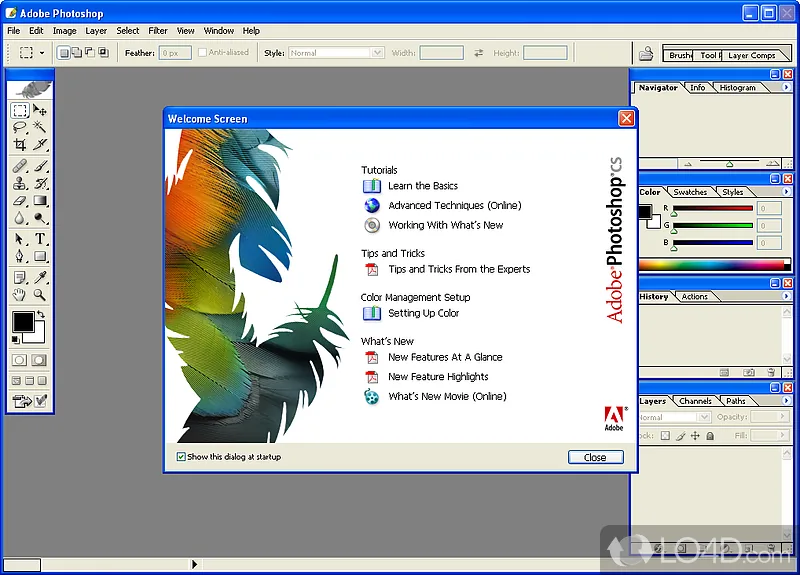
The Creative Suite era arrived in 2003. Photoshop CS, then CS2, CS3, and so on. Each version added something new — Smart Objects, vanishing-point projection, content-aware scaling. By the time CS5 shipped in 2010 with Content-Aware Fill, a feature that could erase entire objects from a photo by guessing what should be behind them, Photoshop felt closer to magic than software.
The subscription years
CS6, in 2012, was the last version of Photoshop you could buy outright. After that, in June 2013, Adobe pulled a controversial move: they switched to a subscription. Photoshop became part of Creative Cloud, and instead of paying once, you paid every month. Forever.
Designers were not happy. Petitions were signed. Articles were written. But it stuck — and it changed the entire software industry. Today almost every creative tool charges a subscription, and Adobe is the company that proved it could work.
In return, updates got faster. New features stopped waiting for big-bang releases. 2020 brought a real Photoshop for iPad. New AI selection tools showed up almost every quarter.
AI takes the wheel
And then in 2024, Adobe added Generative Fill and Generative Expand — powered by their Firefly AI model. You could now select an empty area, type "a cat sitting on a chair," and Photoshop would draw it in.
This was the second time Photoshop redefined image editing. The first was layers in 1994. The second was generative AI in 2024. In between, image editing was mostly about giving humans better brushes. Now the software paints alongside the human.
How it changed the world
Photoshop did not just change software. It changed culture in ways that are still playing out.
It changed advertising. Before Photoshop, retouching a magazine cover took a team of specialists, an airbrush, and a lot of time. After Photoshop, one person at a desk could do it in an afternoon. The look of every billboard, magazine, and product photo you see today was shaped by this.
It changed movies. Industrial Light & Magic — the place where John Knoll worked — used Photoshop on Jurassic Park, on Star Wars prequels, and on hundreds of other films. The matte paintings behind your favorite scenes were almost always touched by it.
It changed photography itself. Photographers stopped needing perfect lighting, perfect framing, or perfect skies. Mistakes that used to ruin a shot could now be fixed. This made photography more forgiving, but also more uniform — everyone's photos started to look "fixed."
It changed how we see beauty. Magazine covers became smoother, thinner, brighter. Skin became flawless. Bodies got reshaped. A whole generation grew up looking at images that were not real, comparing themselves to people who do not exist. This is the part of Photoshop's legacy that is hardest to celebrate.
It changed truth. A photo used to be evidence. After Photoshop, a photo became a starting point. We now live in a world where any image can be questioned — and that mistrust started long before deepfakes existed.
Where we are now
Thirty-five years after that first floppy disk shipped, Photoshop is still the standard. The interface has changed a lot. The features have multiplied. The price went from $895 once to about $22 every month. But the core idea — pixels you can move, layers you can stack, edits you can undo — is the same one Thomas Knoll wrote on his Mac Plus in 1987.
And the story keeps going. Every photo on Instagram is a small descendant of that original program. Every meme. Every ad. Every movie poster. A piece of software written by two brothers as a side project ended up touching almost every image humans look at today.
That is a quiet kind of revolution. The kind that hides in plain sight, until one day you realize you cannot remember what the world looked like before it.
If you mostly need to edit a lot of photos at once instead of one at a time — resizing for the web, adding watermarks, converting formats, removing backgrounds in bulk — Photoshop is overkill. That is what we built RapidPhoto for: a fast, native Mac app for batch photo editing, with a one-time price and no subscription.
More from the blog
Best Batch Photo Editors for Mac in 2026
A head-to-head comparison of the top five
Complete Guide to Batch Photo Editing on Mac
The fundamentals, no Photoshop subscription required
Batch Convert HEIC to JPEG on Mac (3 Methods)
Three ways, free to professional
Batch Watermark Photos on Mac in Seconds
Add text, logo, or image watermarks at scale